

Symetrie technology for your hexapod
Over 25 years’ expertise at the service of your project
WHAT IS A HEXAPOD?
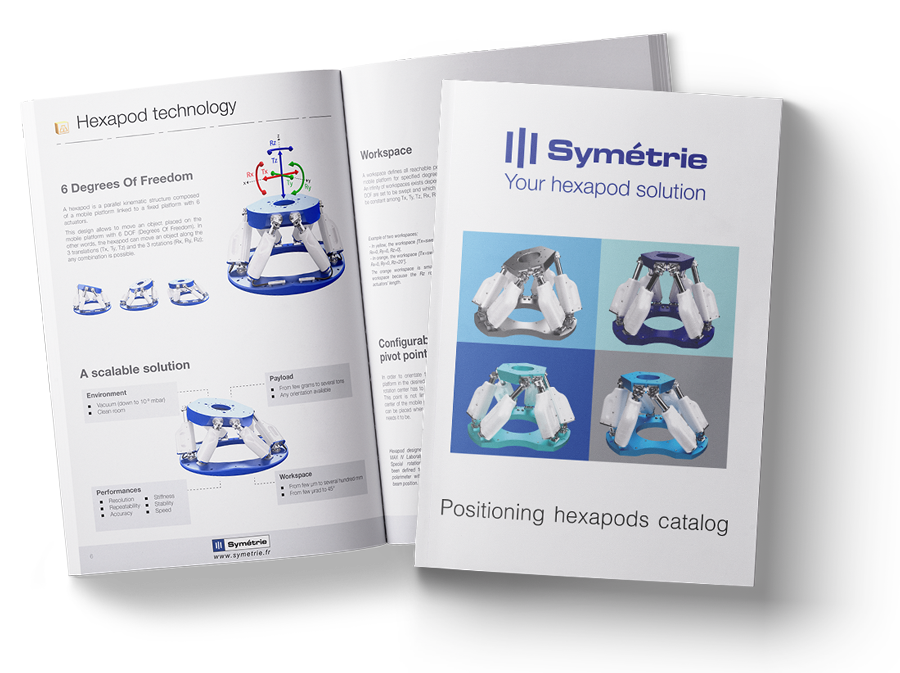
A hexapod is a mechatronic system with a parallel structure allowing the positioning and movement of objects in space according to the six degrees of freedom.
HEXAPOD ARCHITECTURE
A hexapod can be a positioning or a dynamic motion system.
Its architecture consists of six actuators mounted in parallel between a fixed and a mobile platform with the help of joints. The actuators perform linear movements to position the mobile platform.
PRECISION AND DYNAMICS
Symétrie hexapods are designed to be dynamic (simulators) or precise (measuring hexapod or micro-positioning hexapod). Their very low mass-to-stiffness ratio gives them great dynamics with a high load capacity.
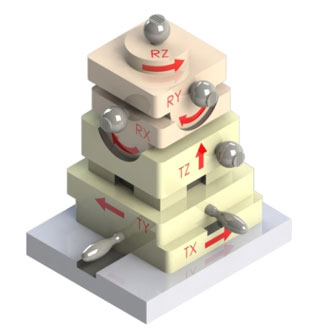
WHY PARALLEL ARCHITECTURE?
■ Better footprint
■ Better mass/stiffness ratio
■ Improved mechanical robustness
■ No moving cables
■ Better accuracy
■ Less risk of default than a serial structure
■ Better inertia


FOR WHAT APPLICATIONS?
Due to its original architecture, this system is used for high precision positioning, position measurement, and the generation of movements in the context of dynamic tests.
Hexapods find their applications in the naval, space, aeronautical, automobile, optical, medical, nuclear, or electronic industries. These systems are also used by research laboratories.
Some of our hexapods exist in an empty, cleanroom or non-magnetic version to adapt to particular environments.
Expertise recognized worldwide














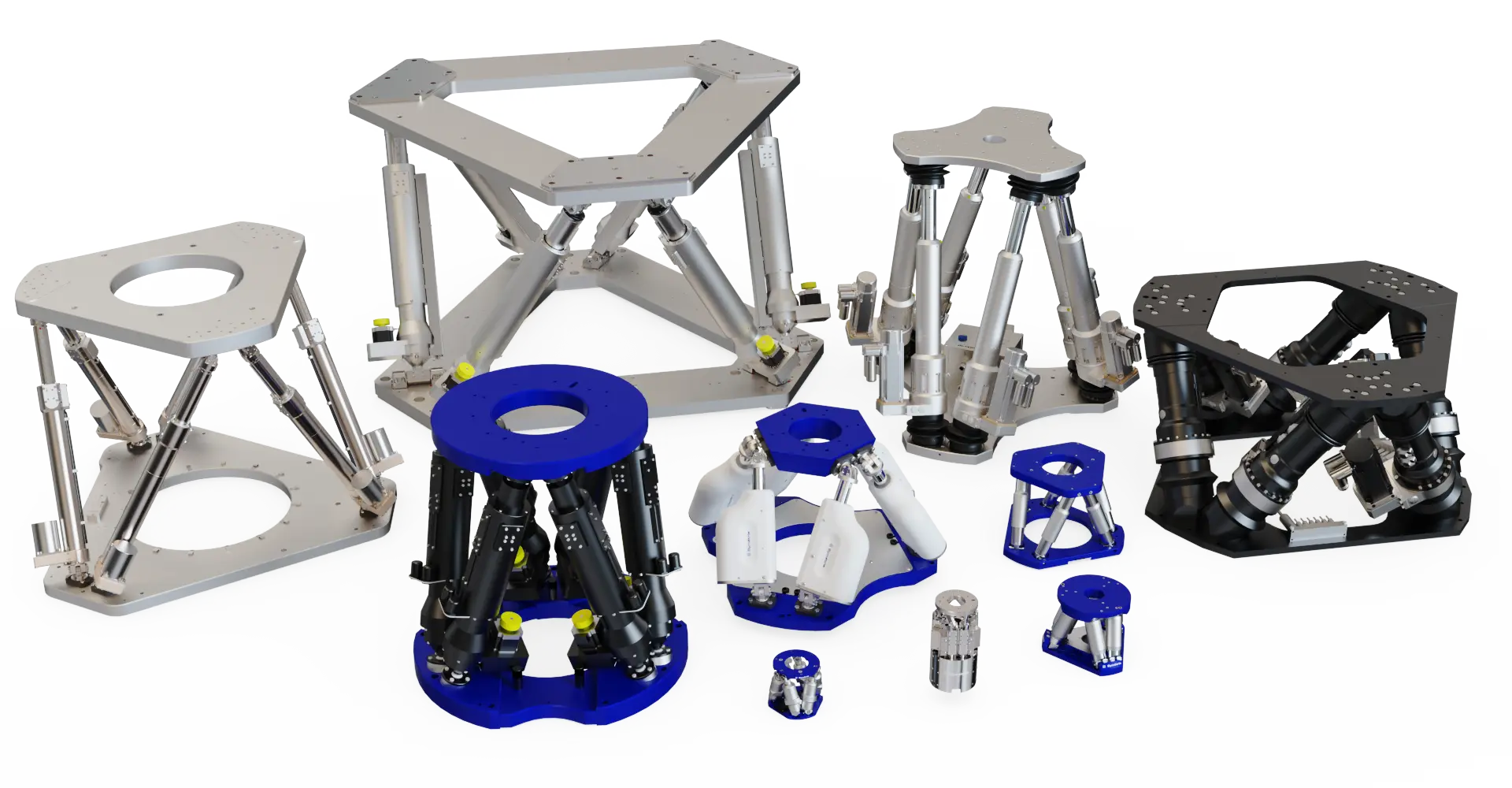
Discover our wide range of precision positioning hexapods stages for loads from a few grams to several tons and resolutions from 10 nm to a few tenths of a micron.
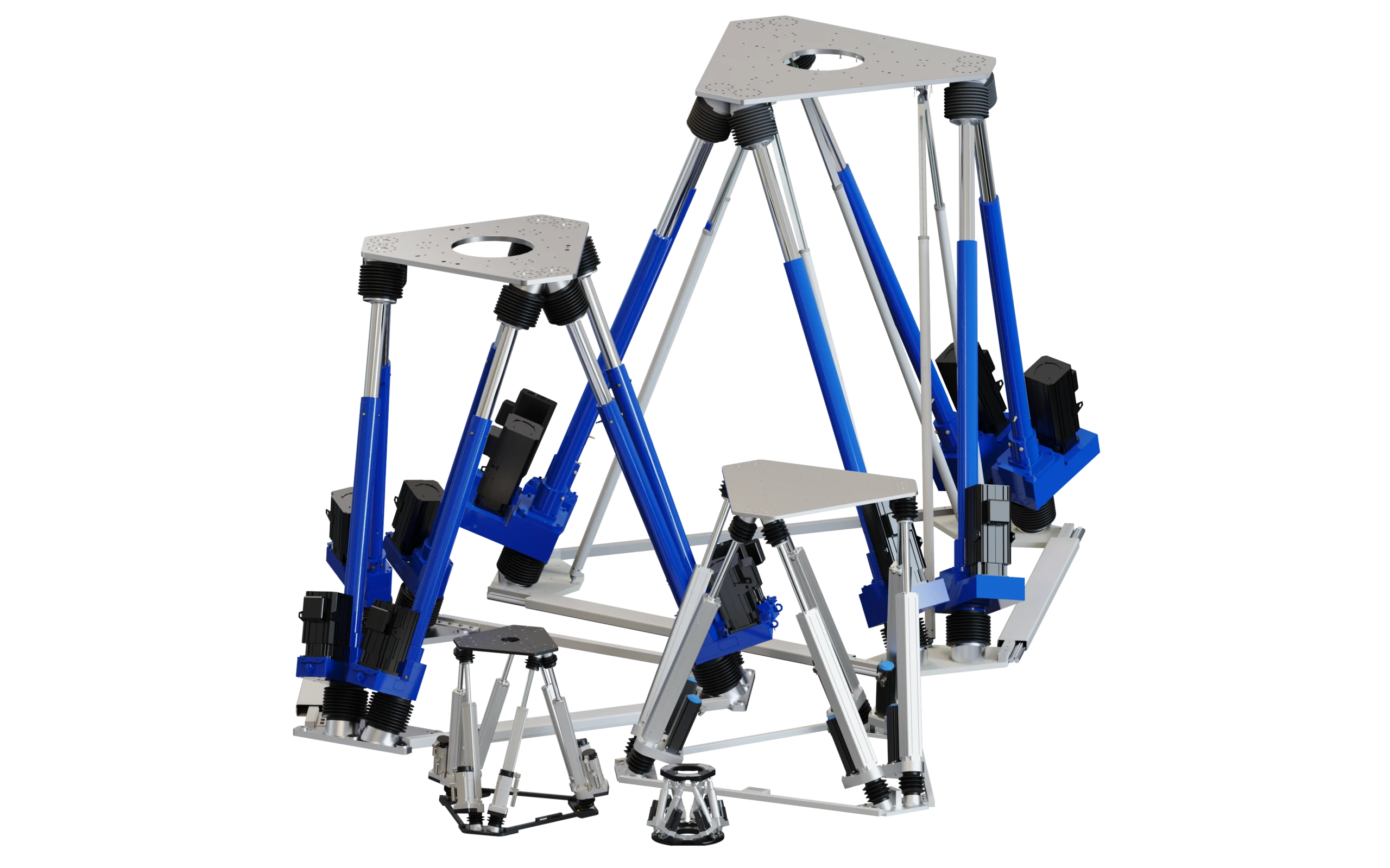
We help you succeed in your dynamic motion projects, allowing you to test objects weighing from a few kg to several tons with up to 2m/s speed and 1g acceleration.
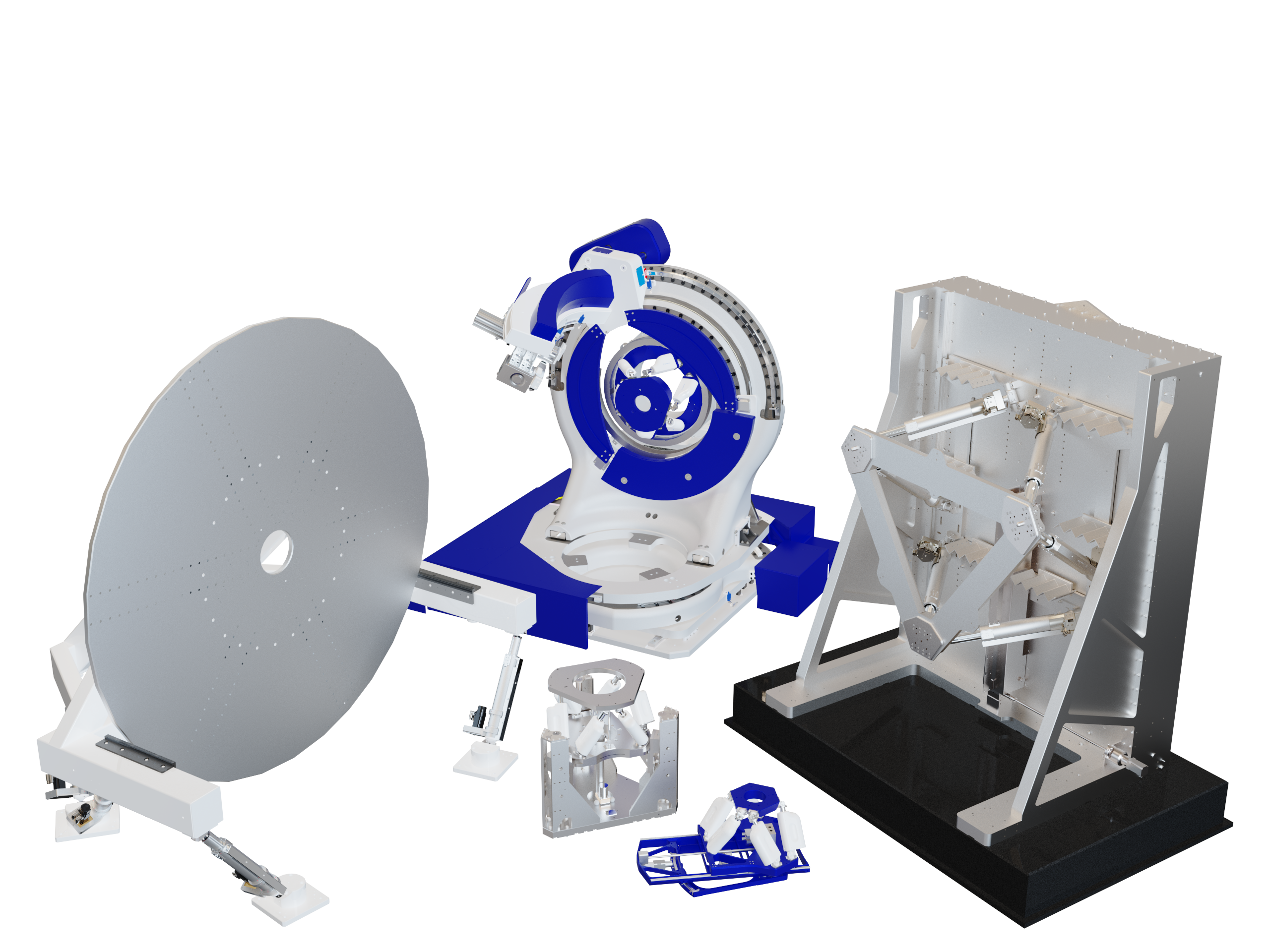
From the feasibility study to maintenance, Symetrie uses its skills in metrology, dynamics and positioning to offer you the best solutions, adapted to your constraints.
Symétrie, hexapod expert for 25 years
Our precision positioning experts are here to answer your technical questions and help you choose the solution best suited to your application.
FAQ
What kinds of movements can the Symétrie hexapod perform?
The hexapod can perform combined movements across its six degrees of freedom: three translations (X, Y, Z) and three rotations (Rx, Ry, Rz). This flexibility allows for complex adjustments that would be impossible with conventional guidance systems.
What is the accuracy or resolution of the movements?
Our hexapods achieve resolutions of around 50 nm for linear motion and a few microradians for rotational motion. Repeatability is one of our key strengths, ensuring the accuracy of every positioning operation.
What materials are used to make the hexapod?
We use high-performance materials such as anodised aerospace-grade aluminium, stainless steel and components specifically designed for demanding environments (vacuum, cleanroom, non-magnetic).
Is it compatible with different software or control systems?
Absolutely. We provide function libraries (SDKs) compatible with LabVIEW, C++ and Python, as well as specific interfaces for research environments such as EPICS and TANGO.
Is the hexapod safe for use in laboratories or in industry?
Safety and reliability are at the heart of our design. The software features configurable travel limits, virtual collision detection and hardware safety features to protect your equipment and samples.
Can’t find the answer to your question?
Send us your enquiry and one of our experts will get back to you as soon as possible.