

What is a Hexapod?
A sub-micrometer precision positioning platform
DEFINITION
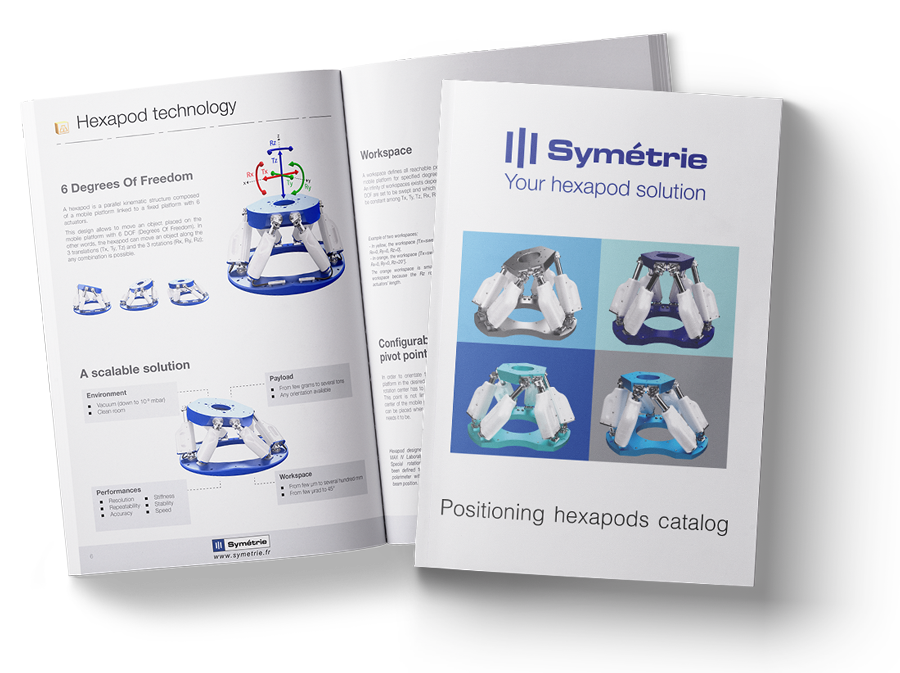
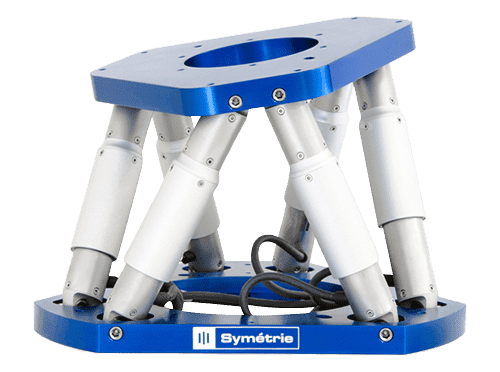
The hexapod is a high-precision mechatronic system with a parallel structure that enables the positioning and movement of objects in space according to the six degrees of freedom (translation in the X, Y, and Z axes, and rotation about the Rx, Ry, and Rz axes). This hexapod platform, also known as a Stewart platform or parallel robot, offers exceptional rigidity and nanometer-level precision thanks to its design featuring six actuator cylinders. Hexapod systems are used in demanding industrial and scientific applications such as optical alignment, motion simulation, astronomy, and precision metrology.
BRIEF HISTORY

In the 1800s, Augustin Louis Cauchy, a pioneer in mathematical analysis, studied the stiffness of an “articulated octahedron,” considered the theoretical precursor of the modern hexapod.
In 1949, V. Eric Gough, an engineer at Dunlop in England, built the first practical parallel mechanism for testing tires under different loads. In 1965, D. Stewart used a variation of this system for flight simulators.
The robot was subsequently renamed the “Stewart platform,” although the term “Gough-Stewart platform” is historically more accurate. Over the decades, the hexapod has been refined by numerous engineers and researchers (Klaus Cappel, H. McCallion, etc.), evolving into the high-precision systems we know today.
HEXAPOD VS ROBOTIC ARM
Although these two positioning solutions are often compared in industrial fields, they have many differences and address specific needs.
| Critère | Hexapode | Robot sériel |
| Degrés de liberté | 6 DDL simultanés (Tx, Ty, Tz, Rx, Ry, Rz) | Axes empilés indépendants |
| Rigidité | Très élevée (structure fermée) | Plus faible (axes superposés) |
| Encombrement | Compact et intégré (axes superposés) | Plus volumineux (axes empilés) |
| Précision | Excellente répétabilité | Cumul d'erreurs des axes |
| Cinématique | Parallèle | Sérielle |
HEXAPOD & ROBOTIC ARM: A HYBRID ARCHITECTURE
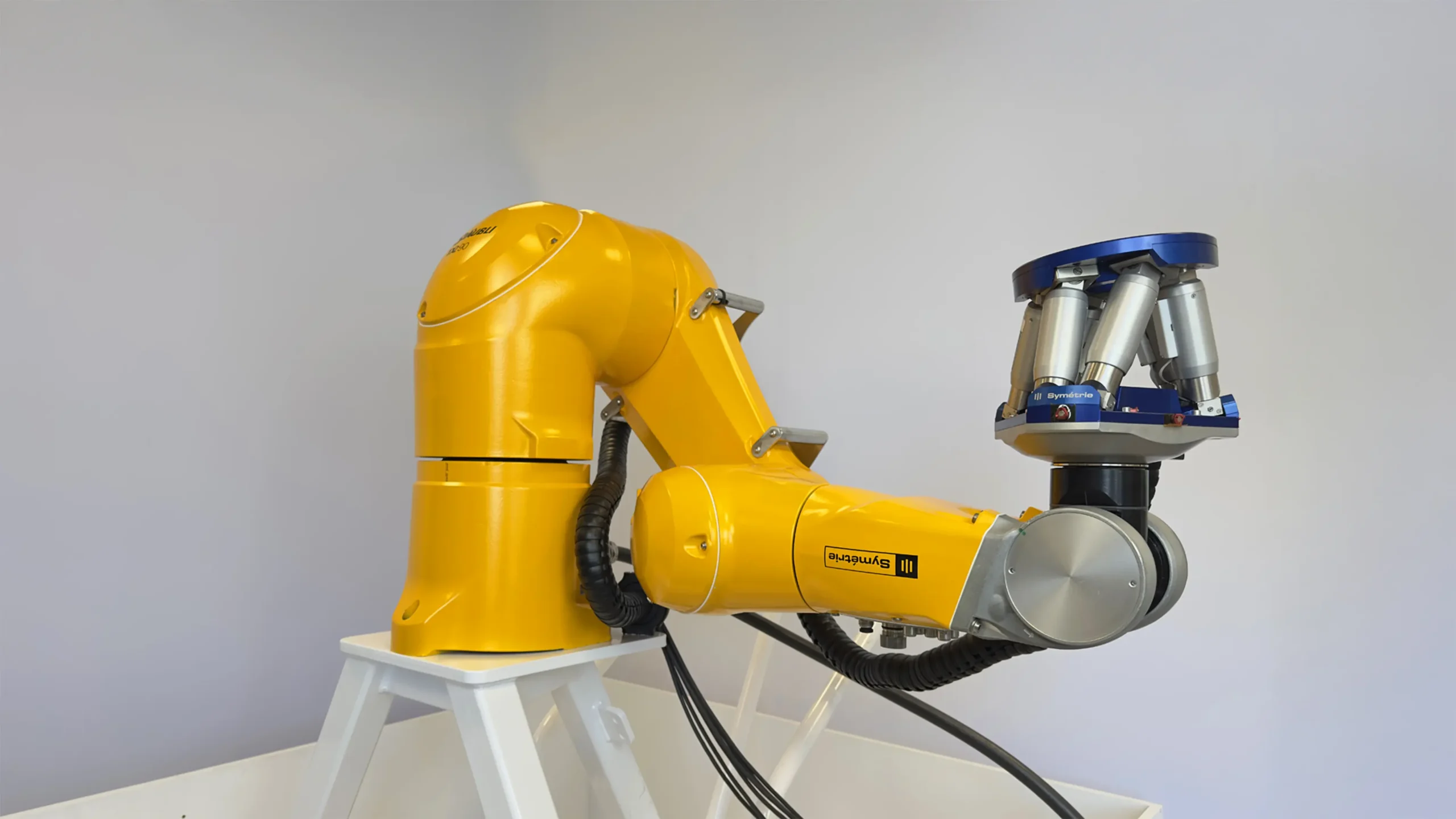
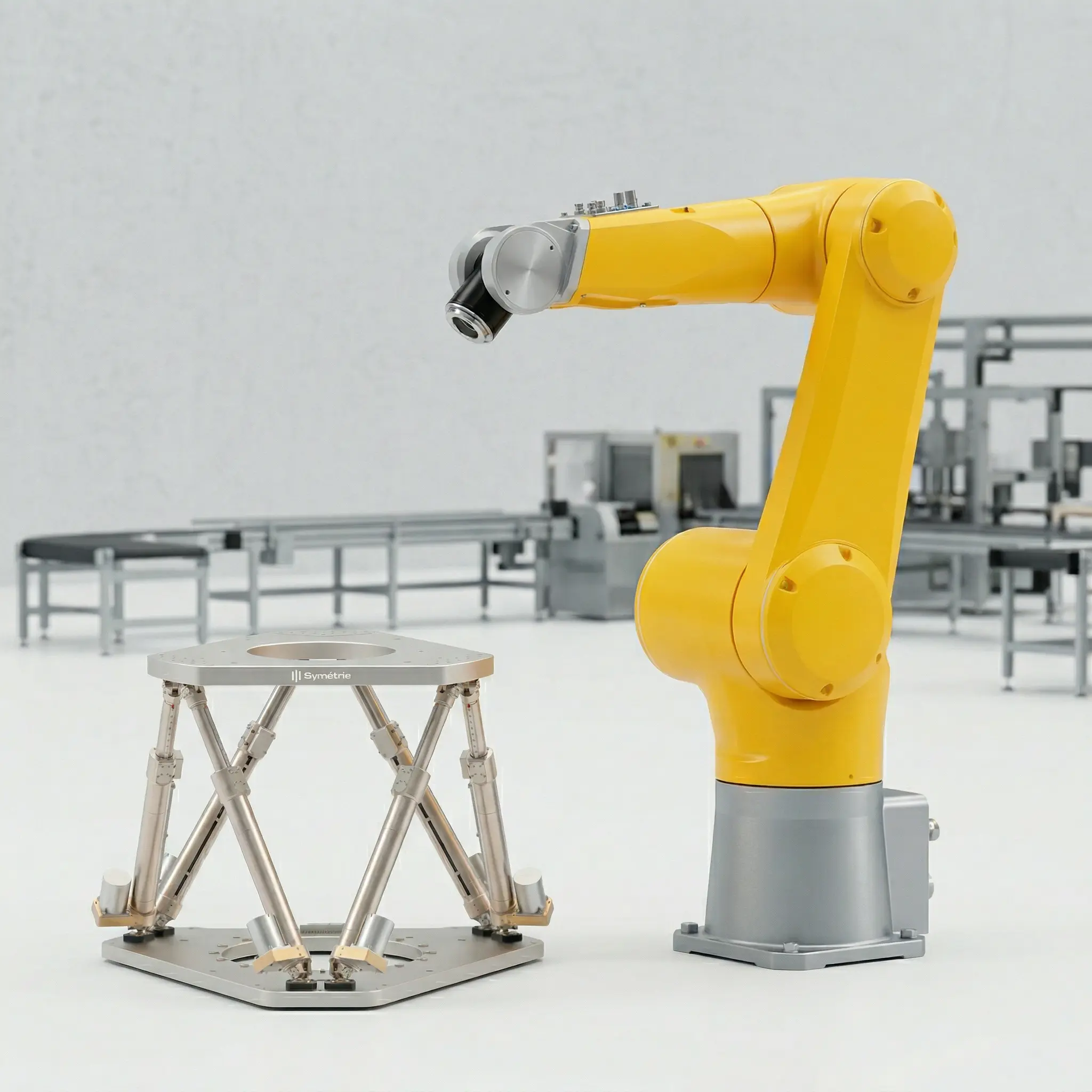
Combining a robotic arm with a hexapod allows us to bring together the best of both worlds: the reach and speed of a serial robot with the precision and rigidity of a parallel mechanism.
The arm ensures rapid overall positioning, while the hexapod performs micrometric adjustments and orientation corrections in real time. This complementary kinematic design paves the way for high-value-added applications: precision machining, optical calibration, high-tolerance assembly, adaptive polishing, and automated inspection.
Thanks to this hybrid architecture, the robotic cell gains in precision, flexibility, and responsiveness, while reducing calibration times and improving process quality.
HEXAPOD VS STAGES
Two approaches to multi-axis positioning: the parallel kinematics of the hexapod versus the stacking of conventional translation and rotation stages.
| Critère | Hexapode | Tables translations/rotations |
| Architecture | Cinématique parallèle (6 actionneurs simultanés) | Axes superposés (X, Y, Z, Rx, Ry, Rz) |
| Encombrement | Compact, centre de gravité bas | Volumineux (accumulation des axes) |
| Rigidité dynamique | Excellente (structure fermée) | Dégradée par l'empilement |
| Charge utile | Répartie sur 6 actionneurs | Supportée par l'axe inférieur |
| Précision de pose | Mouvements couplés, pas d'accumulation d'erreur | Erreurs cumulatives des axes |
| Temps de réponse | Rapide (6 DDL simultanés) | Séquentiel ou synchronisé |
| Complexité de contrôle | Cinématique inverse en temps réel | Contrôle direct par axe |
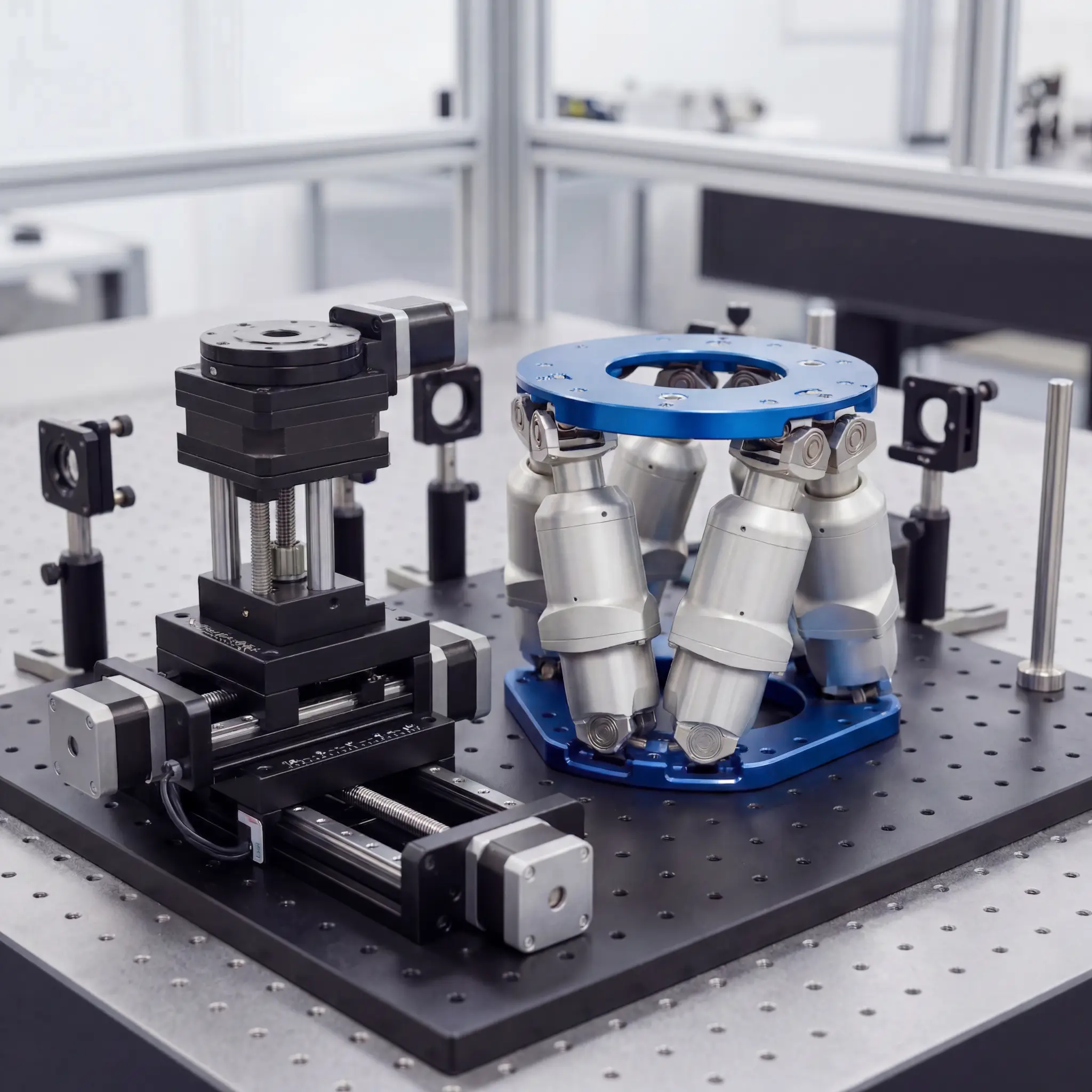
HEXAPOD & STAGES: MAXIMUM ADAPTABILITY

Combining a hexapod with translation and rotation stages provides a comprehensive solution for demanding applications that require both a long stroke and exceptional precision.
The translation tables provide long-range linear motion, while the hexapod delivers micrometer-level precision and multi-axis rotation capabilities. This configuration optimizes the workspace while maintaining maximum rigidity and unmatched positioning repeatability.
This modular architecture is used in the fields of dimensional metrology, precision optical alignment, aerospace test benches, and any environment where high-precision 6-axis positioning is required over large work surfaces.
Expertise recognized worldwide
















a turnkey solution
Each Symétrie hexapod comes with all the components needed for immediate use: a complete mechatronic system, a dedicated controller, and integrated control software.
Hexapod
Controller
Software
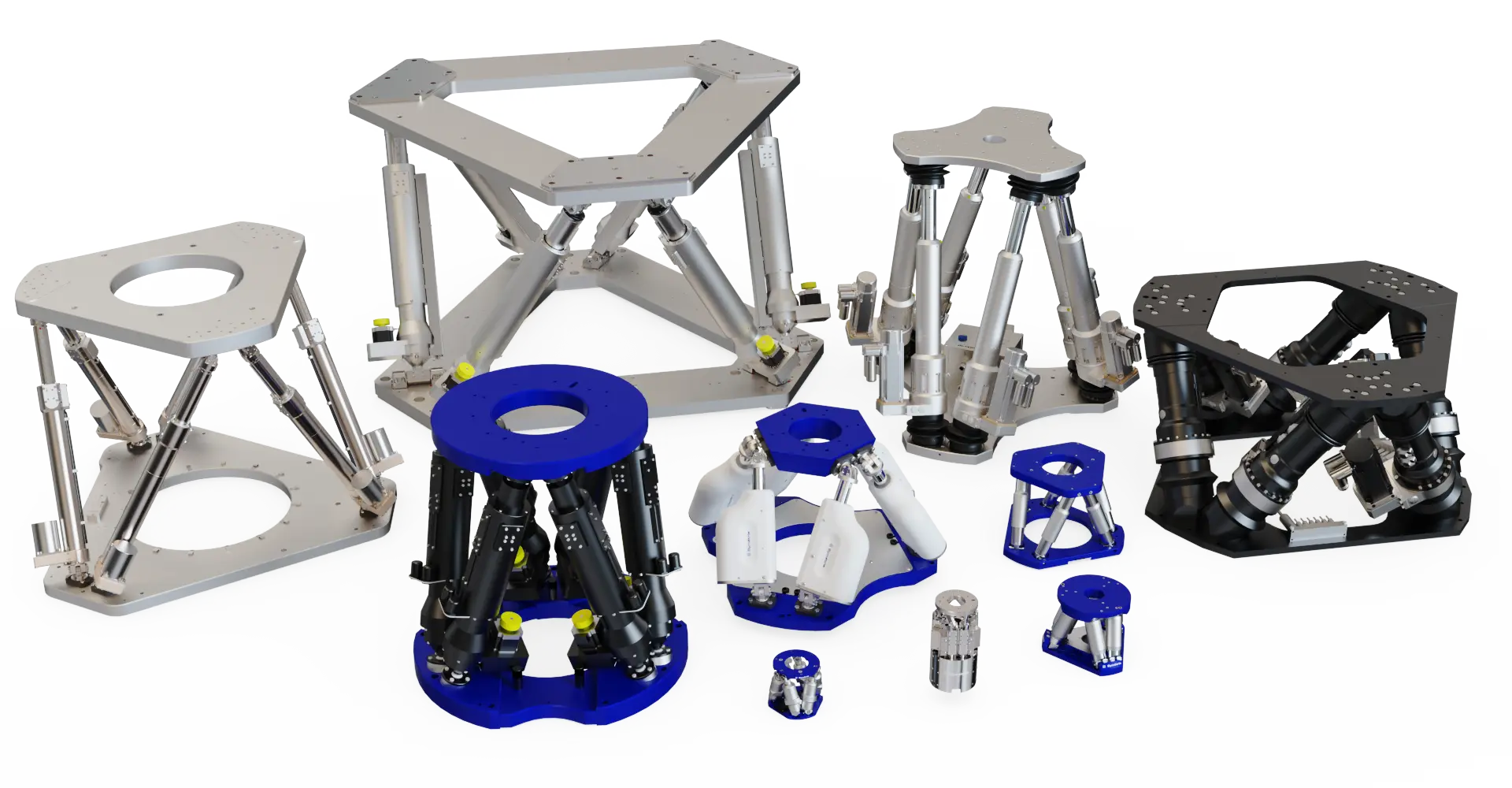
Discover our range of precision positioning hexapods for loads ranging from a few grams to several metric tons.
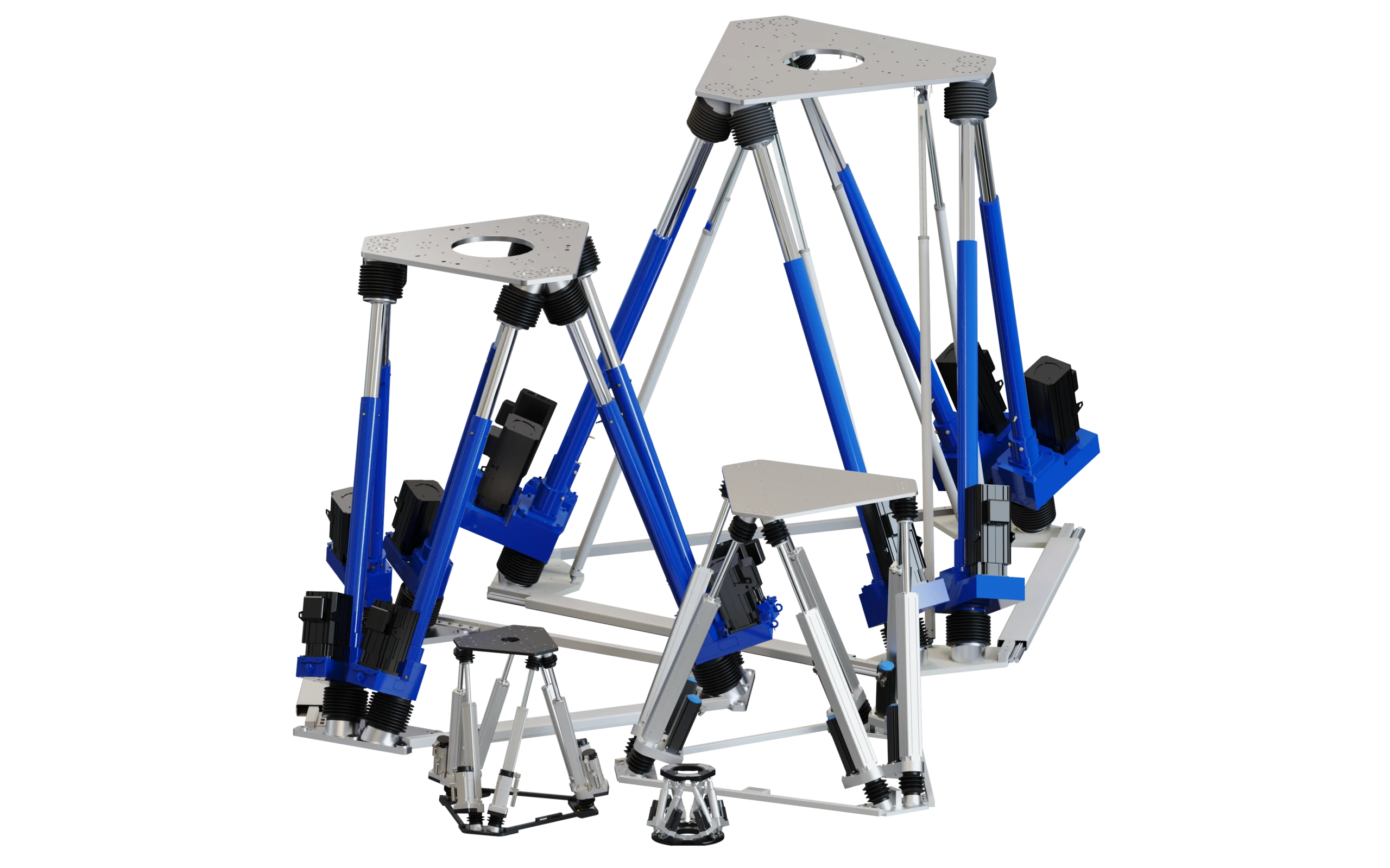
Our motion hexapods are used as dynamic test systems capable of generating trajectories with speeds of 1 m/s and accelerations of 1 g.
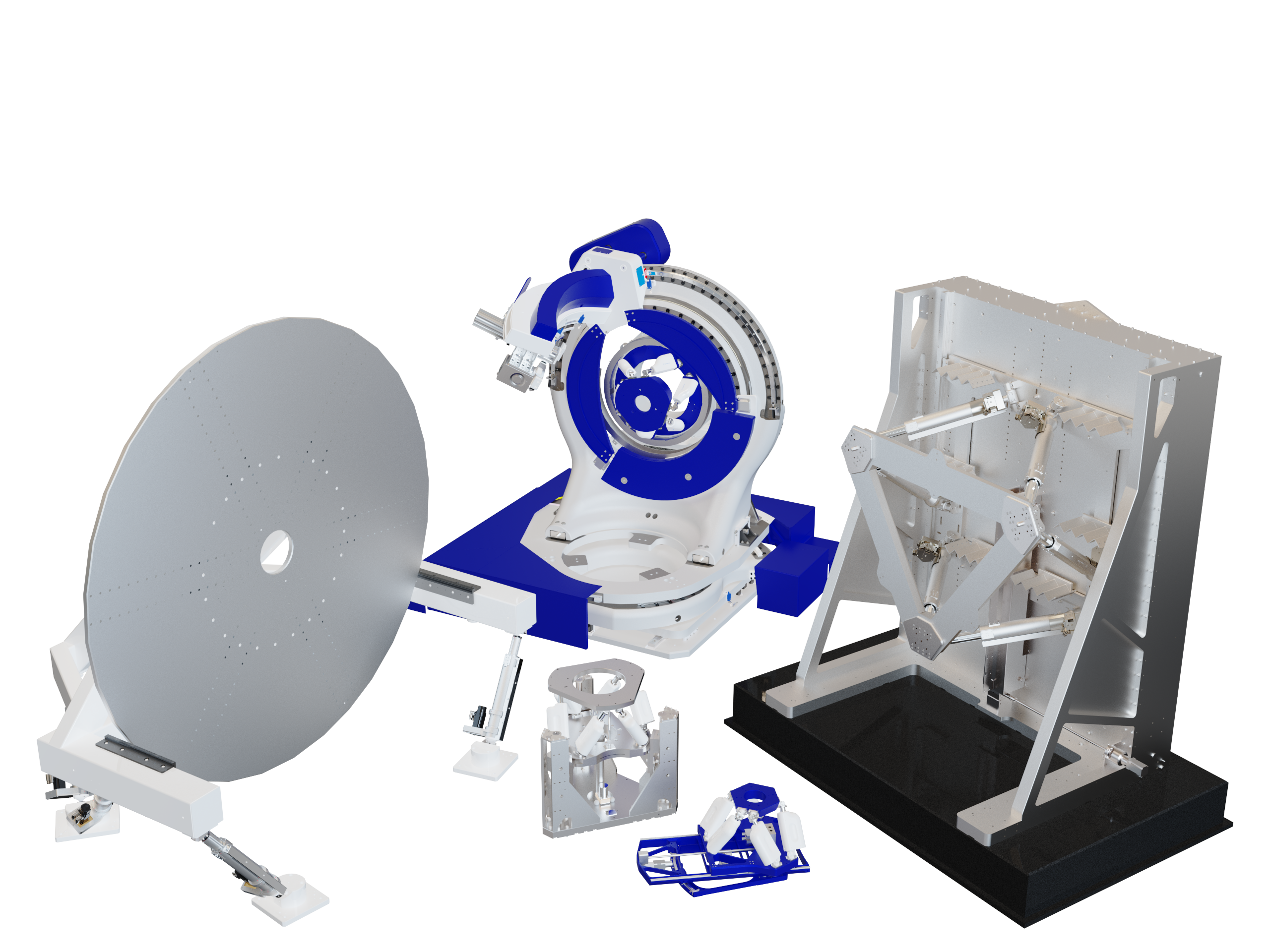
From feasibility studies to maintenance, Symétrie leverages its expertise in dynamics and positioning to provide you with the best solutions.