

Stewart Platform: 6-DOF Parallel Platform
What is a Stewart platform?
How does a Stewart platform work?
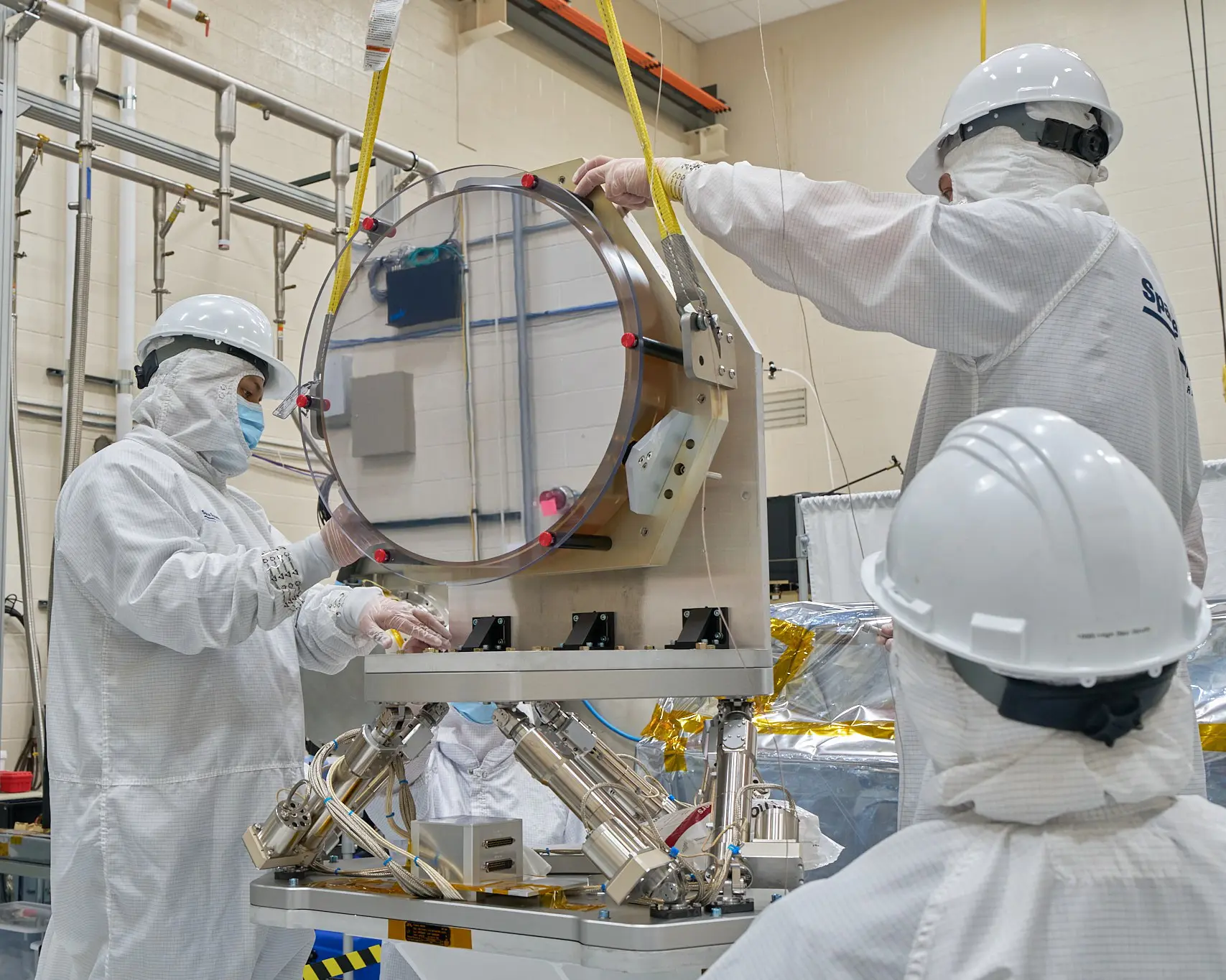
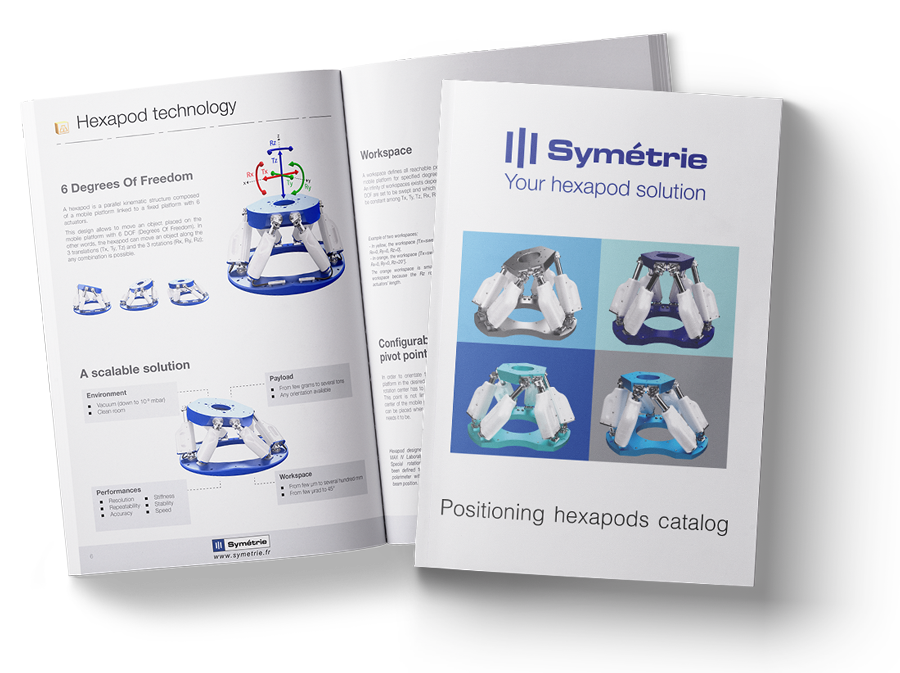
A Stewart platform is a parallel kinematic structure comprising a moving platform connected to a fixed platform by six linear actuators operating in synchronisation.
This design allows an object placed on the moving platform to be moved with six degrees of freedom (DOF). In other words, the hexapod can move an object along the three translational axes (Tx, Ty, Tz) and the three rotational axes (Rx, Ry, Rz); all combinations are possible.
This technology, which stems from mechatronics, is particularly well suited to applications requiring precise, complex positioning along several axes within any given coordinate system. Consequently, an object placed on the movable platform can be positioned, adjusted and assembled simply and easily.
Expertise recognized worldwide















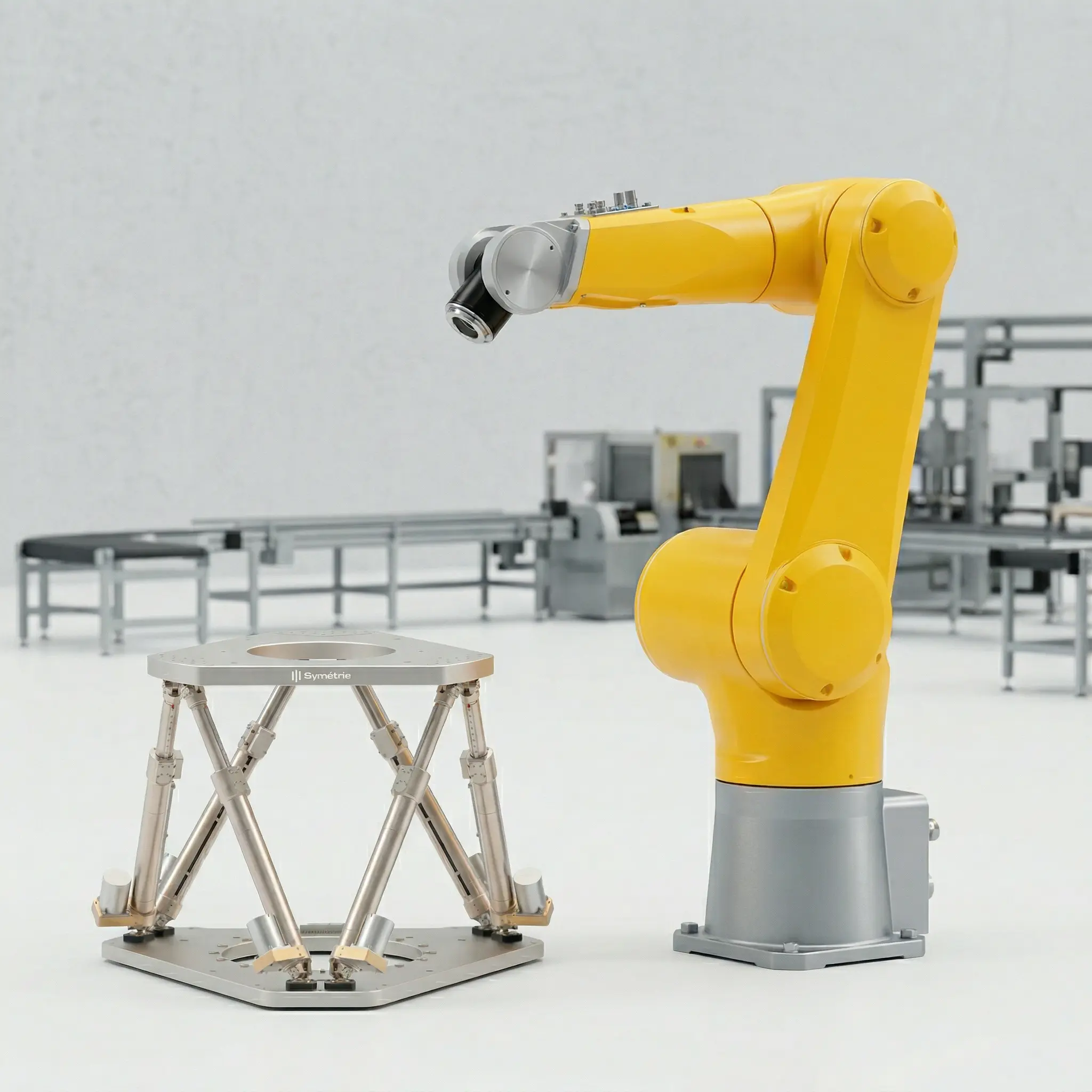
STEWART PLATFORM VS ROBOTIC ARM
Although these two positioning solutions are often compared within the industry, they do, however, have many differences and are designed to meet specific needs.
| Requirements | Stewart Platform | Robotic Arm |
| Degrees of freedom | 6DOF simultaneous (Tx, Ty, Tz, Rx, Ry, Rz) | Independent stacked axes |
| Stiffness | Very high (closed structure) | Lower (overlapping axes) |
| Footprint | Compact and integrated (stacked axes) | Larger (stacked axes) |
| Precision | Excellent repeatability | Cumulative errors of the axes |
| Kinematics | Parallel | Serial |
STEWART PLATFORM & ROBOTIC ARM: A HYBRID ARCHITECTURE
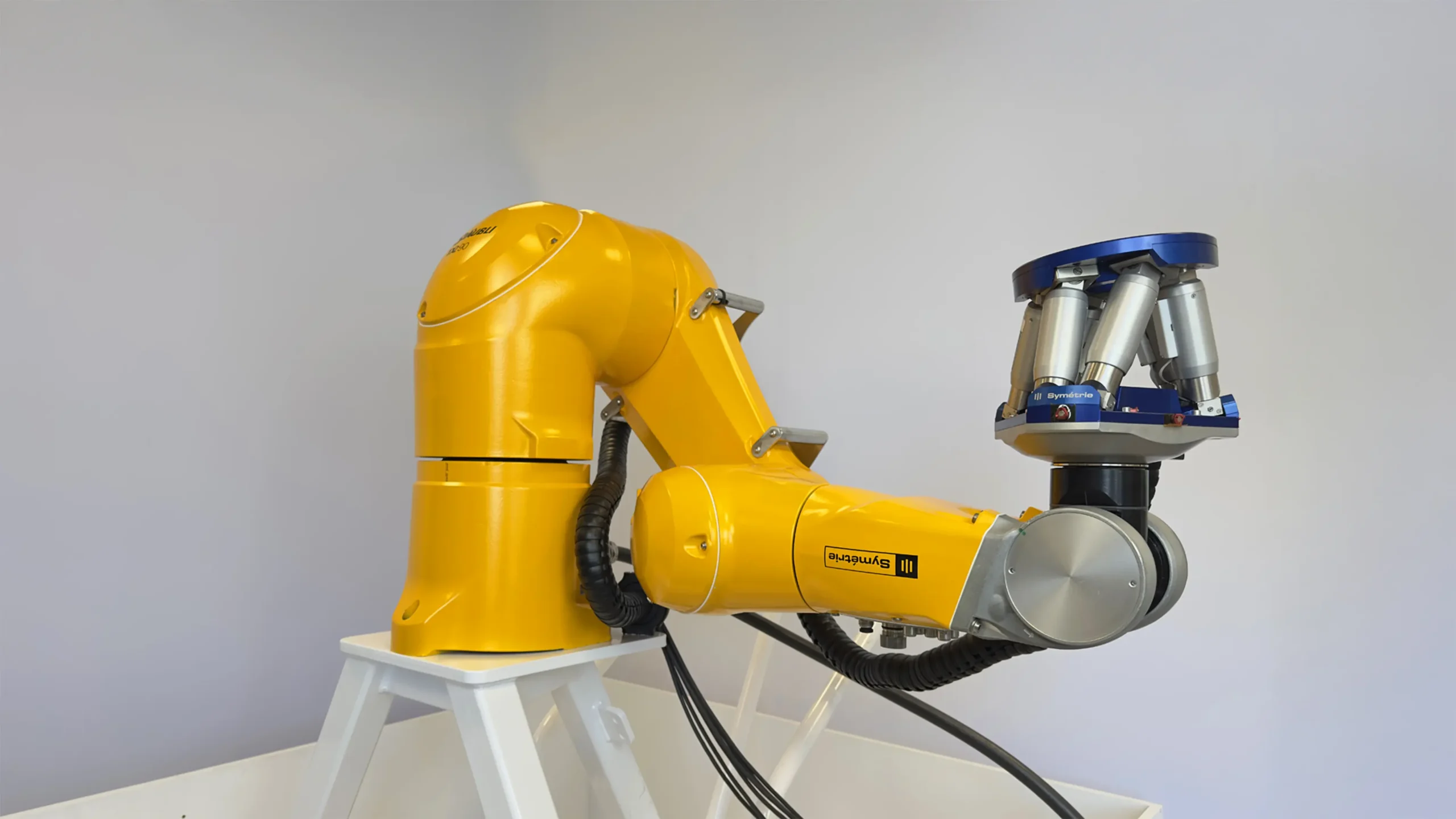
Combining a robotic arm with a Stewart platform brings together the best of both worlds: the reach and speed of a serial robot with the precision and rigidity of a parallel mechanism.
The arm ensures rapid overall positioning, whilst the platform carries out micrometric adjustments and orientation corrections in real time. This kinematic complementarity paves the way for high value-added applications: precision machining, optical calibration, high-tolerance assembly, adaptive polishing, and automated inspection.
Thanks to this hybrid architecture, the robotic cell gains in precision, flexibility and responsiveness, whilst reducing calibration times and improving process quality.
STEWART PLATFORM VS STAGES
Two approaches to multi-axis positioning: the parallel kinematics of the Stewart platform versus the stacking of conventional translation and rotation axes.
| Requirements | Stewart Platform | Rotary/Linear Stages |
| Architecture | Parallel kinematics (6 simultaneous actuators) | Overlapping axes (X, Y, Z, Rx, Ry, Rz) |
| Footprint | Compact, low center of gravity | Voluminous (axis accumulation) |
| Dynamic stiffness | Excellent (closed structure) | Degraded by stacking |
| Payload | Distributed between 6 actuators | Supported by the bottom axis |
| Accuracy | Coupled movements, no error accumulation | Cumulative axis errors |
| Response time | Fast (6 simultaneous DOF) | Sequential or synchronized |
| Control Complexity | Real-time inverse kinematics | Direct control per axis |
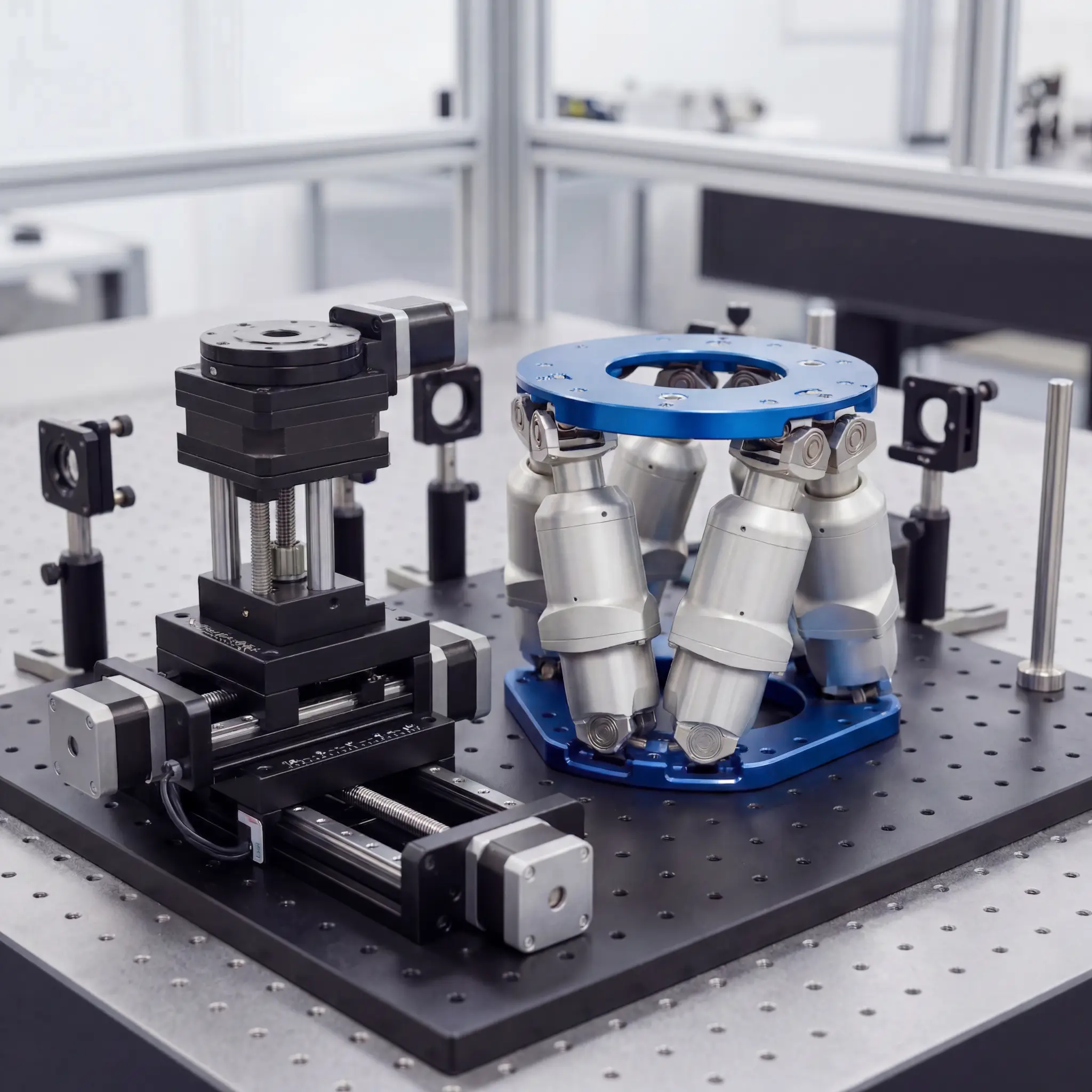
STEWART PLATFORM & STAGES: MAXIMUM FLEXIBILITY

Combining a Stewart platform with translation and rotation stages provides a comprehensive solution for demanding applications requiring both a long stroke and exceptional precision.
The translation stages provide large linear movements, whilst the platform delivers micrometric precision and multi-axis rotation capabilities. This configuration optimises the working space whilst maintaining maximum rigidity and unrivalled positioning repeatability.
This modular architecture is used in the fields of dimensional metrology, precision optical alignment, aerospace test benches, and all environments where high-precision 6-axis positioning is required across large working areas.
a turnkey solution
Every Symétrie Stewart Platform comes with all the components required for immediate deployment: a complete mechatronic system, a dedicated controller and integrated control software.
STEWART PLATFORM
CONTROLLER
SOFTWARE

Discover our range of precision positioning hexapods for loads ranging from a few grams to several tonnes.

Our hexapod motion systems are used as dynamic test rigs capable of generating trajectories at speeds of 1 m/s and accelerations of 1 g.

From feasibility studies to maintenance, Symétrie draws on its expertise in dynamics and positioning to offer you the best solutions.
Symétrie, hexapod expert for 25 years
Our precision positioning experts are here to answer your technical questions and help you choose the solution best suited to your application.
FAQ
What kinds of movements can the Symétrie hexapod perform?
The hexapod can perform combined movements across its six degrees of freedom: three translations (X, Y, Z) and three rotations (Rx, Ry, Rz). This flexibility allows for complex adjustments that would be impossible with conventional guidance systems.
What is the accuracy or resolution of the movements?
Our hexapods achieve resolutions of around 50 nm for linear motion and a few microradians for rotational motion. Repeatability is one of our key strengths, ensuring the accuracy of every positioning operation.
What materials are used to make the hexapod?
We use high-performance materials such as anodised aerospace-grade aluminium, stainless steel and components specifically designed for demanding environments (vacuum, cleanroom, non-magnetic).
Is it compatible with different software or control systems?
Absolutely. We provide function libraries (SDKs) compatible with LabVIEW, C++ and Python, as well as specific interfaces for research environments such as EPICS and TANGO.
Is the hexapod safe for use in laboratories or in industry?
Safety and reliability are at the heart of our design. The software features configurable travel limits, virtual collision detection and hardware safety features to protect your equipment and samples.
Can’t find the answer to your question?
Send us your enquiry and one of our experts will get back to you as soon as possible.